
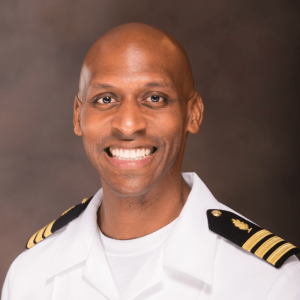
Coleman C. Chandler, Jr.
Deputy Fleet Surgeon
U.S. Navy / COMPACFLT
Coleman Chandler is a Mentor Hawaii Cohort 11 mentor. Learn more about the program here.
About Coleman
Captain Coleman Chandler received his commission in 2003. After completing Officer Indoctrination School in Newport, Rhode Island, he reported to Naval Hospital Great Lakes. He assumed the role of Assistant Department Head for Material Management, responsible for the procurement of medical materials and supplies for the primary medical facility and outlying clinics.
In 2005, he transferred to the 1st Medical Battalion at Camp Pendleton, California. He served in numerous positions, including Company Commander for Alpha Surgical Company (In-Garrison), Assistant Operations Officer (S-3A), and Battalion Adjutant. During his time in the battalion, he deployed a team of medical professionals to support Operation Enduring Freedom. He was responsible for providing robust medical care to U.S. Marine Corps, Special Operations, Joint, and coalition forces.
After his tour with the U.S. Marine Corps, he transferred to Yokosuka, Japan in 2008, reporting to the staff of U.S. Seventh Fleet. Due to his extensive operational experience with the Marine Corps, he served as Chief of Medical Plans and Operations, and on various occasions as the Deputy Fleet Surgeon. During this assignment, he planned and participated in numerous contingencies and fleet exercises.
Captain Chandler has a Bachelor of Arts from Stephen F. Austin State University, a Master of Public Health degree from Texas A&M School of Public Health, a Master of Arts in Defense and Strategic Studies, and is a graduate of the Maritime Advanced Warfighting School at the U.S. Naval War College.
Question and Answer with Coleman
What is your preferred communication style when mentoring (in-person, video conference, phone, informal check-ins, structured meetings, etc.)?
In-Person, Video Conference, Phone Call, Text / SMS
Why do you want to become a mentor in this program?
I am committed to paying it forward for the guidance and support I received earlier in my career as a Young Professional. By sharing my experiences as both a Young Professional and a Senior Healthcare Executive, I aim to offer valuable lessons learned from both successes and challenges. These insights will help others navigate personnel and managerial situations with a more practical approach. Ultimately, my goal is to give back to the Hawaii community.
What specific skills, knowledge or experience can you share with your mentee?
I will share with my mentee a diverse set of skills and knowledge that reflect my experience in leadership, project management, and strategic operations. Specifically, I will provide insights on effective leadership principles and techniques, grounded in practical experience leading cross-functional teams. My expertise in project management will guide them in developing and executing complex initiatives, ensuring they understand the nuances of time, scope, and resource management.
Additionally, I will mentor them in multinational and bilateral negotiations, equipping them with the skills needed to navigate diverse cultural dynamics and drive successful outcomes. Drawing from my experience in medical modeling and simulation, data analysis, and operational research, I will help them understand how to leverage data to inform decisions and improve operational efficiency. I will also share my experience in policy and program development, as well as operational plans development, to help them understand the processes of crafting impactful strategies and implementing them effectively.
Furthermore, I will teach them to identify problems early, analyze challenges from multiple perspectives, and approach solutions with innovation and adaptability, ensuring they are prepared for the evolving demands of leadership in any environment.
What are your expectations for a mentor-mentee relationship?
My expectations for the mentor-mentee relationship are centered around mutual respect, open communication, and a shared commitment to growth. I expect to provide guidance, support, and actionable insights that help my mentee navigate both current challenges and future opportunities. In return, I hope for an open dialogue where my mentee actively engages, seeks feedback, and applies the lessons learned to their personal and professional development. Ultimately, I aim to foster a relationship built on trust, allowing for candid discussions and a collaborative approach to achieving their goals.
How do you approach problem-solving and conflict resolution?
I approach problem-solving and conflict resolution using a structured, methodical approach based on the Joint Military Decision-Making Process (JMDMP). This includes:
Identify the problem: Clearly define the issue at hand by gathering all relevant information, ensuring that perspectives are considered.
Analyze the situation: Break down the problem using critical thinking, assessing potential impacts on mission objectives, resources, and timelines.
Develop options: Work collaboratively with key stakeholders to generate a range of solutions, ensuring alignment with strategic goals and operational requirements.
Evaluate options: Weigh the pros and cons of each option, factoring in risks, feasibility, and desired outcomes.
Make a decision: Choose the best course of action based on data-driven insights and input from subject-matter experts.
Implement and assess: Once a solution is selected, implement it with clear communication, detailed execution plans, and continuous assessment to ensure effectiveness.
Throughout this process, I maintain a focus on collaboration, transparency, and accountability, ensuring that all stakeholders are engaged, and conflicts are resolved efficiently while aligning with the overall mission goals. This framework is similar to other conflict and decision making used in the civilian sector.
How do you envision success for your mentee, and how will you measure it during the program?
To me, success in the mentorship program is about more than just ticking off a list of goals. It’s about real, meaningful progress and growth. Here’s how I look at it:
Achieving Goals: At the start, we set some clear, practical goals—whether it’s mastering a new skill, leading a project, or moving forward in their career. Success is measured by how well we hit those targets, but it’s not just about the outcome—it’s about the effort and commitment along the way.
Building Skills: I pay attention to how my mentee develops in key areas like problem-solving, communication, and teamwork. Success shows up when they confidently take on new challenges and grow into roles that stretch them. We track this progress through regular conversations and feedback, making sure to celebrate the wins, no matter how small.
Personal Growth: Success also means seeing my mentee become more self-aware and confident in their own abilities. When they start taking feedback in stride and using it to improve, and when they grow more comfortable taking ownership of their development, I know we’re on the right track.
In the end, success is about more than just reaching goals—it’s about the journey of learning, growing, and becoming a more confident and capable leader.