
Honolulu Star-Advertiser: High school students push for safe spaces, opportunities
February 8, 2026
By Victoria Budiono
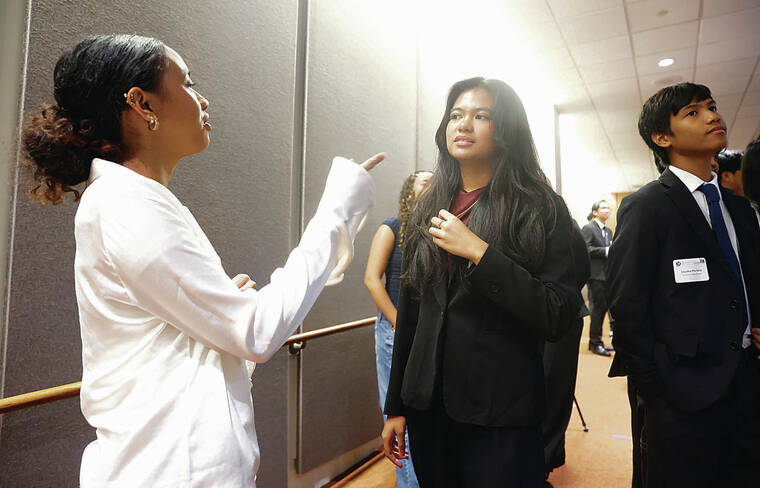
More than 80 public high school students filled the state Capitol Friday morning, not for a tour, but to press lawmakers with firsthand accounts of safety concerns and other issues they said could help boost success in and out of the classroom.
The students from Waipahu, Radford, Kapolei and Campbell high schools took part in the student advocacy day that paired policy workshops with direct meetings with legislators. The event centered on youth leadership and civic engagement, with students pitching solutions to real community challenges, especially teen delinquency, violence in their neighborhoods and on campus, and the lack of accessible after-school spaces.
Xayna Jarra, a 16-year-old junior at Campbell High who lives in Waianae, said recent violent incidents involving young people have been unsettling.
“There’s a lot of safety concerns,” she said. “Firearms and gun laws, especially when it comes into the hands of young people, are scary.”
Jarra pointed to the recently launched school resource officer pilot program that places police officers at Waianae, Kapolei and Kaimuki high schools. Officials say the program emphasizes mentorship, relationship-building and campus safety rather than routine discipline, and Jarra said she hopes similar efforts will expand to more schools.
For now, she said, schools can strengthen safety by extending awareness and life-skills education beyond the classroom through after- school and extracurricular programs that focus on relationship-building and community.
While Campbell High has a solid sense of campus community, Jarra said there is still room to make those spaces more inclusive and more engaging for all students.
“Learning does not just happen in the classroom,” she said. “It’s not enough.”
STUDENTS repeatedly emphasized the need for more safe, supervised places to gather after school where teens can study, socialize and participate in programs.
Alexis LEI Magbag, a 17-year-old Campbell junior, noted that many public libraries have limited and inconsistent hours — with most closing by late afternoon, some closed entirely on certain days and only a handful open as late as 7 p.m. — limiting safe after-school options for students.
She added that some parks can feel unsafe for teens at certain hours, particularly where there are large encampments of homeless individuals.
“We need more community spaces,” Magbag said. “After-school programs or places to hang out and study together, play together — that’s super important for youth.”
Magbag said boredom, loneliness and unstable home environments can push some teens toward risky behavior. She and Jarra said students are more likely to get into trouble when they lack constructive outlets and accessible opportunities, which can leave them discouraged about their future, disengaged from school and more prone to poor decision-making.
“Teens sometimes do bad stuff because they’re misunderstood, feel unheard, and kind of just lash out,” Magbag said, emphasizing that access to supportive spaces can help at-risk teens succeed.
THE CAPITOL visitors also offered varied perspectives on how to better inspire and motivate students. Some said engagement is high when opportunities are visible and relevant; others said burnout among both students and teachers is a concern.
“Some teachers are really trying but they’re overworked,” Magbag said. “I’m so scared they’re going to quit because of how tired they get.”
She also raised concerns about teacher safety, referencing a recent incident in which a Campbell High teacher was reportedly assaulted.
“They’re just doing their jobs and trying their best,” she said. “They need a better work environment, more breaks, higher pay to deal with everything.”
Lakeisha Quitog, a 16-year-old sophomore at Waipahu High, said her experience has been largely positive, crediting a wide range of campus programs and close relationships with teachers, who she said are regularly recognized and celebrated by students.
“Most of the kids in my school are super-motivated,” she said. “A big part is all the opportunities that are made available to us.”
Waipahu students said student engagement also lifts teachers, creating a positive feedback loop in which motivated students energize educators and stronger teaching further boosts student interest.
Waipahu Principal Zach Sheets told lawmakers the school’s academy model, which organizes students into career-themed academies, has helped transform both campus culture and community perception.
Under the model, students pursue themed pathways such as health sciences, engineering, public service, natural resources and the arts. Core subjects like English and math are taught through the lens of each academy, making lessons more relevant, he said.
“We want students to pursue their purpose and passion,” Sheets said. “They’re happier to attend school because it’s something they want to learn.”
Programs include hands-on, real-world experiences: Culinary students run a functioning restaurant with wait staff and management roles; automotive students work in auto shops; and students in health pathways gain exposure to clinics and medical settings.
Many seniors participate in internships and project- based learning tied to industry partners.
Sydnee Augustin, a 16-year-old Waipahu junior in the health and sciences academy, said early exposure to medical fields has shaped her goals. Through school, she has visited diagnostic labs and learned about radiology, experiences she said are rare even for some college students.
“To not even (have graduated) high school and have that experience is so cool,” Augustin said. “It helps me build a career path and be ready and feel curious at a younger age.”
STATE REP. Justin Woodson, chair of the House Education Committee, was among the lawmakers participating in the student advocacy day. He said hearing directly from students provides valuable insight for policymakers.
Woodson (D, Kahului- Puunene) said their concerns about after-school spaces and library hours had not been previously raised with him and he intends to follow up and explore support options, noting continuing operational challenges across the state library system.
Woodson also pointed to career-connected learning and academy-style pathways as a hallmark of high- performing education systems.
“You’re exposing students to immediate opportunities that are available to them while they’re in high school and after,” he said. “These are pathways we know the community needs, and students are interested in them, so they thrive.”
Most importantly, Woodson said, students should understand that civic participation can lead to change.
“Students should know that their voices matter,” he said. “That is how democracy works and it’s a beautiful thing. Community members share their concerns, and that should produce a positive result. Their voices are heard, their voices are welcomed, and we want to hear from them.”
Read the full story here.