
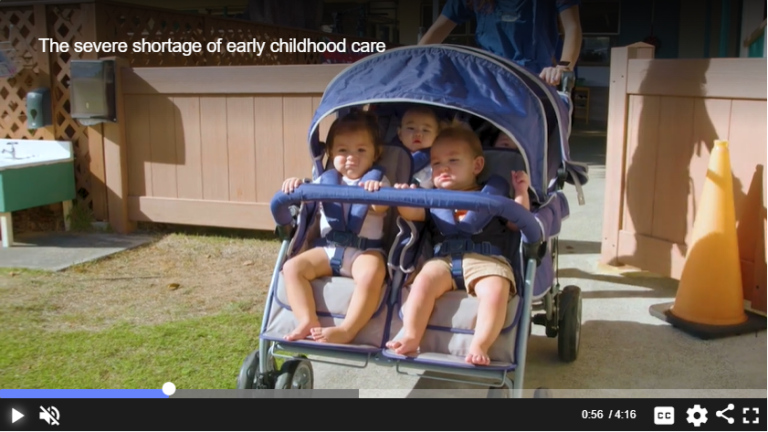
Living 808: The severe shortage of early childhood care
February 9, 2026
HONOLULU (KHON2) — If you’ve ever been a working parent struggling to find childcare for your keiki, you are not alone.
There is a 25 to 30 percent shortage of early childhood and social service professionals in Hawaii, who are leaving the field because of low pay and limited career options.
The result? Licensed childcare is at a premium – with space for only about one-quarter of Hawaii’s children under 5 years old.
Wait lists are long, leaving hundreds of families in childcare limbo.
“We’ve got a pre-school, for instance, in Kailua, Aikahi area, that last year alone had over 300 phone calls just for infants and toddlers. And a program that’s licensed for about 20 infants and toddlers,” said Dana Vela, president and CEO, Kama’aina Kids.
Hundreds of families are being turned away because there simply aren’t enough early childhood educators and caregivers to handle the demand. This goes for A-Plus Afterschool programs as well.
“Being able to attract and retain high-quality staff is absolutely one of our biggest challenges. Interestingly, we have empty classrooms. We’ve had to close classrooms and shorten our hours, opening later and closing sooner during the day, so that we can use the staff we have wisely. And so, we’re serving less children than we could be serving if we did have enough staff,” Vela said.
In turn, the shortage is having a major impact on Hawaii’s workforce and economy.
“Childcare is an integral part of the greater business community. In general, we are an essential part of business, which we realized during the COVID pandemic. And, for the most part, folks can’t go to work unless we do,” said Vela.
A recent report by the Chamber of Commerce Hawaii and the US Chamber of Commerce Foundation found that the economic impact from childcare shortages in Hawaii is critical, costing the state nearly $1.2 billion annually.
Employers in Hawaii also lose about $787 million a year because of child-care-related turnover and absenteeism, with another estimated $396 million in tax revenue losses.
Overall, half of the parents polled reported that someone in their family left a job, declined to take a job, or changed jobs because of childcare problems.
“What we found was that childcare here really is a workplace infrastructure issue, much like housing could be considered one as well,” said Nadia Holt, associate director, community impact/Chamber of Commerce Hawaii. “Parents who are working miss fewer workdays when they have the right support. So, when our working parents don’t have access to reliable and affordable childcare, the employer feels that immediately. And that’s in absenteeism, and direct cost to the employer as well as in cost lost in productivity.”
As a result, employers are being required to be creative in their efforts to retain employees.
“So, employers are finding that they have to be quite adaptive to maintain their skilled talent as part of their team, and to save on those turnover costs,” Holt said.
All agree – the solution to this crisis must be a multi-faceted effort involving various stakeholders such as government leaders, lawmakers, parents, and the community.
“The best way for the community to come together would be creating solutions to support us with overhead, perhaps through philanthropic or large employer contributions, to support childcare so that people can get back to work,” Vela suggested.
“We also need a greater paradigm shift to elevate the field in general. Too often, you hear ‘glorified babysitter,’ but that’s not really how they should be regarded. That’s not what they offer in their services and expertise. And their pay needs to reflect that.
See the story here.