
Aloha State Daily: 'Chief of War' actor Kaina Makua, community leaders talk culture, workforce wins and woes
October 19, 2026
By Kelsey Kukaua Medeiros
“Hawaiʻi cannot be a copy of some place else’s future.”
“You cannot wait for the future to start preparing for it.”
“For workforce, it’s not one person’s or agency’s responsibility, but everyone’s”
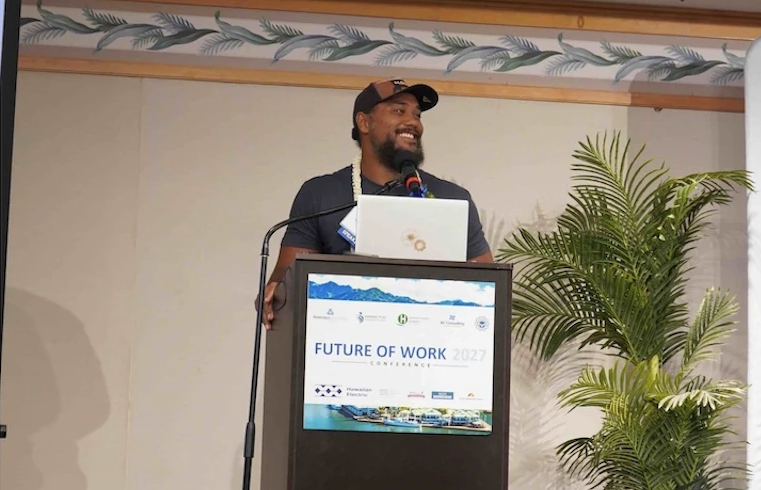
Bennette Misalucha, executive director of the state Workforce Development Council, said this and more in the first two minutes of the Future of Work Conference 2027, which welcomed more than 300 community leaders to the Japanese Cultural Center on Sept. 23.
The day-long conference was held in partnership with the Chamber of Commerce Hawaiʻi. Attendees participated in breakout sessions, surveys and discussions to exchange perspectives and build partnerships, organizers said in a recent announcement.
“The Future of Work Conference reminds us that no single organization can address Hawaiʻi’s workforce challenges alone,” Misalucha said in a statement. “By bringing employers, educators, workforce leaders and government partners together, we create opportunities to align our efforts, strengthen partnerships and develop solutions that benefit our people and industries.
“Our hope is that the conversations and connections made during the Future of Work 2027 conference will lead to lasting collaboration and meaningful action. Ultimately, the success of this conference will be measured by what we accomplish in the future, by creating opportunities for Hawaiʻi’s people to learn, work, thrive, here at home.”
Chamber of Commerce Hawaiʻi’s President and CEO Sherry Menor shared the meaning behind this year’s theme: “Rooted in Culture. Ready for the Future.”
“It really speaks to the conversation we need to have in Hawaiʻi. The future of work is already here,” she said at the event. “Industries are evolving and employers are looking for news ways to attract, develop and retain talent. But as we prepare for what’s ahead, we have an opportunity to stay grounded – what makes our Islands truly special and unique are our people, our culture, and our sense of place.
“That’s why workforce development is such an important part of the 2030 Blueprint for Hawaiʻi: a roadmap to transform our economy and strengthen our competitiveness. It’s about creating opportunities for people. … Because the future of our workforce and the future of our economy are inseparable.”
Menor noted that the blueprint aligns with the state’s generational workforce commitment, “so that by 2045, all Hawaiʻi residents have a path to a career.”
“We need government, community leaders working together to build stronger pathways for people, connecting education with opportunity, and creating careers that allow local talent to build their futures here,” she continued.
Lord Ryan Lizardo, the chamber’s vice president of education and workforce development, told ASD that this annual event is intended to showcase how workforce is changing across sectors, share an economic forecast, and recognize individuals and organizations contributing to that work.
“One goal is to support talent, while helping employers find that local talent,” he said, noting that paying a good, living wage can be a challenge.
Chamber of Commerce Hawaiʻi’s Associate Director of Education Sophia Wibholm shared how it was “cool to see so many K-12 teachers” in attendance.
“It’s great for them to hear from the industry leaders and apply what they learn into their classrooms,” she told ASD. “At the chamber. we are looking to improve classroom pathways (to careers) for different industries, whether that’s internships, externships, etc. … I really like [Department of Education] Superintendent Keith Hayashi’s vision of ‘Globally competitive and locally committed.”
Kaina Makua — a Native Hawaiian taro farmer and nonprofit leader, outrigger canoe coach, and actor who played King Kamehameha I in Apple TV series “Chief of War” — served as keynote speaker at this year’s conference.
Makua, who was barefoot, performed an ʻoli and spoke ʻōlelo at first, sharing the moʻolelo of his parents and kūpuna who came before them.
“Think about one of your kūpuna that taught you about your identity,” he posed to the audience.
He told stories of surviving Hurricane Iniki, fishing with his father, having difficulty reading from grade school on up and being pursued by Jason Mamoa, with a central theme of not compromising on who you are no matter the circumstances.
When Makua finally agreed to take on the role of King Kamehameha I, he said he committed to learning the language he spoke and way of living he practiced. He recalled only speaking ʻōlelo Hawaiʻi on set, and if others wanted to converse, they had to learn it, too, or they needed a translator.
“The crazy thing was they all wanted to learn, and they created such an amzing enviornment that I think Holywood has never see,” he said. “Stick yo your roots, stick to you, and be your truth. Know who you are and stand there because that is unique, and that’s what the world gonna ask for very soon.”
Last month, Makua mobilized Kumano I Ke Ala to provide hundreds of free bags of poi to the community in need, he told ASD.
Steven Bond-Smith of the University of Hawaiʻi Economic Research Organization, or UHERO, followed by examining the trends shaping Hawaiʻi’s industries, employers and workforce needs. Later on that day, local speakers representing the fields of healthcare, construction, the public sector, defense, energy, information technology and tourism, took the stage.
Some interesting tidbits that came up from industry presenters included:
- Earlier this year, Healthcare Association of Hawaiʻi unveiled its first innovative ‘Aulama I Ke Ola health learning lab at Wai’anae High School, allowing students to practice real-life clinical skills. The next learning lab will launch at Waiākea High School in Hilo next fall, according to Janna Hoshide, HAH’s VP of healthcare workforce development.
- There are nearly 40,000 people who work in construction statewide, and industry appointment is projected to grow 5.4% over the next decade. “Apprenticeships offer another strong path in the industry. You earn a wage while learning a trade, often without taking on significant educational debt,” said Cheryl Walthall, executive director at General Contractors Association of Hawaiʻi. “It typically takes 4 to 5 years to become a journeyperson, with potential at full-time to earn over $100,00 a year. These are careers that can give local people the means to stay, work and build a life-long career.”
- For those interested in a government job (and benefits), there are “4,000 vacancies across the board,” according to state Department of Human Resources Development Brenna Hashimoto. Currently, the state is looking to hire entry-level roles spanning office assistants, to adult correction officers, conservationists and social workers. Hashimoto has been a state worker for nearly four decades.
- “Defense tech is a bipartisan national priority. The federal government is betting on these industries,” said Kimberly Lehn of Pacific Forum, noting that opportunity for growth lies in Artificial Intelligence, data and cybersecurity, energy and resilience, advanced manufacturing and more.
The event also recognized seven individuals and organizations contributing to change, including Eric Gill with UNITE HERE Local 5 and David DeLuz of the Hawaiʻi County Workforce Development Board, as well as State Rep. Andrew Takuya Garrett; Kazu Hayashida, manager of workforce planning at Hawaiian Electric; Melvin Dizon of Waiʻanae Coast Comprehensive Health Center; Chentelle Rowland, executive director of Maui Workforce Development Board; and Matthew Stevens, executive director of Hawaiʻi Workforce Funders Collaborative.
Read the story here.