
Auto Notion: Pearl Harbor is mid-rebuild, and the crane is the cheap part
July 29, 2026
By Luis Reyes
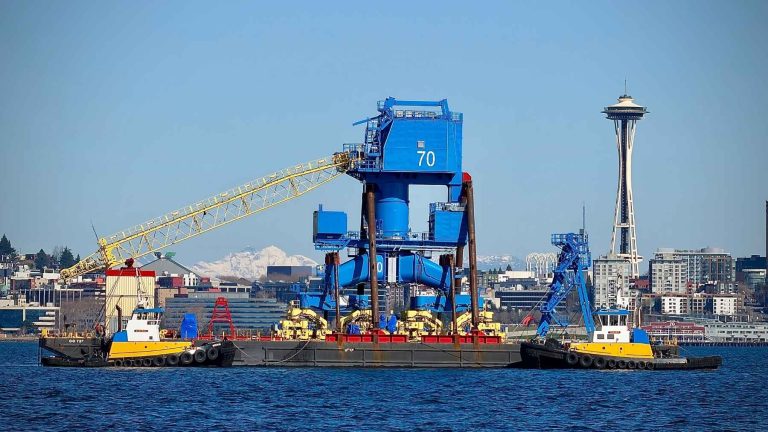
Really big machines usually solve the shipping problem by coming apart. Wind turbine blades get police escorts, transformers get their own rail cars, and most oversize industrial hardware arrives at its destination in pieces, ready for reassembly. The Navy’s newest shipyard crane is skipping all of that.
It left Manitowoc, Wisconsin, on May 29 fully assembled, all 200 feet of it, standing upright on a barge behind a tugboat named Ocean Tower. The destination is Pearl Harbor Naval Shipyard in Hawaii, roughly 9,000 nautical miles away according to The Maritime Executive, by the only route that works: out through the Great Lakes and the St. Lawrence Seaway, down the Atlantic coast, through the Panama Canal and across the Pacific.
Pearl Harbor is mid-rebuild, and the crane is the cheap part
When P-82 arrives, it becomes the tenth crane at Pearl Harbor Naval Shipyard and Intermediate Maintenance Facility. Its job is straightforward: hoist parts and equipment up to the highest points of ships and submarines sitting in dry dock, per the shipyard.
The yard it is joining is in the middle of the largest construction project in Navy history. Dry Dock 5 carries a maximum project value of $3.4 billion, and Hawaii’s Chamber of Commerce expects the total investment to reach around $4.2 billion by the time it is done. It is the first new dry dock at Pearl Harbor since 1943.
The reason is simple enough. The dock it replaces, Dry Dock 3, is too small and too shallow for the Virginia-class attack submarines that now make up the working core of the fleet. The new dock is designed for a 150-year service life and is scheduled to wrap up in 2028.
Against numbers like that, the cranes are almost a rounding error. Going by the Navy’s contract awards, they run somewhere around $50 million apiece. So the 20-story machine currently crossing an ocean standing up is, in budget terms, the small purchase.
One detail in the design tells you a lot about these old yards. Konecranes built the base to run on multiple rail sizes and shapes, straight or curved, because the Navy’s century-old shipyards each laid their tracks differently. Heavy machinery adapting itself to 1919-era infrastructure is a fair summary of this entire program. It is the same kind of oversized, one-off industrial work as the paired cranes assembling a fusion reactor in France, just pointed at submarines instead of plasma.
Read the full story here.