
Honolulu Star-Advertiser: Storm caused millions in lost sales, bookings, revenue
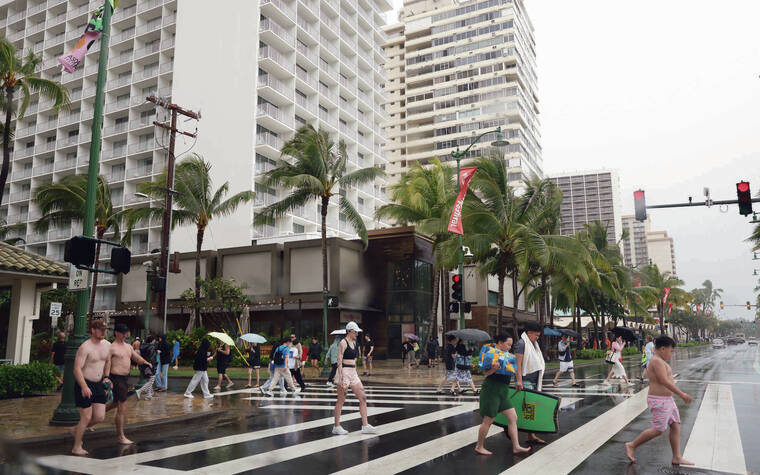
Photo by Jamm Aquino
March 17, 2026
By Dan Nakaso
Canceled hotel bookings and flights and lost revenue from darkened hotel restaurants, bars and other closed tourist attractions that began with Friday’s storm conservatively added up to a weekend loss of at least $35 million to $40 million, according to the Hawaii Hotel Alliance.
The true financial loss could skyrocket in the coming days as businesses across the state continued to mop up and dry out on Monday, said Jerry Gibson, president of the Hawaii Hotel Alliance.
“All islands had a tough time,” Gibson said. “What we found was a lot of cancellations.”
The true financial cost will come from multiple segments of Hawaii’s economy, including grocery stores across the state that lost power and had to throw out perishable food and send employees home, especially servers, bartenders, valets and others who did not earn their usual tips.
The storm especially affected Oahu’s North Shore, where some hotel guests had to be relocated to Waikiki, where several resorts also were flooded or lost power.
There were reports that several Waikiki hotels, including the Sheraton Princess Kaiulani Waikiki Beach, had been flooded.
Like some other Waikiki resorts, a spokesperson for the Princess Kaiulani said that it will take “a couple of days” for the resort’s corporate parent, Marriott International, Inc., to respond with a statement.
Local retailers, including City Mill, continued to serve customers in the dark as they shopped for flashlights, batteries and other storm-related supplies.
“Several of our store locations — including Pearl City, Ewa Beach, Kaimuki, Kaneohe, Mililani, and Hawaii Kai — lost power during the storm,” Sandra Hee, City Mill’s director of logistics and inventory management, said in a statement to the Honolulu Star- Advertiser. “Our teams shifted quickly allowing the stores to stay open, using natural light and flashlights to escort customers through the aisles to help them find the supplies they needed.
“Our Hawaii Kai store faced the most challenges, as it was without power and internet through Saturday,” Hee said. “Despite no power or internet, our Hawaii Kai store remained open and conducted sales on a cash-only basis.”
From the sales perspective, City Mill — despite its darkened aisles— nevertheless “saw a steady stream of customers in every store through the weekend,” Hee said. “Most popular items in demand were flashlights, batteries, propane, butane, and power banks. Once the rain hit, the demand moved to sandbags, tarps, generators, and wet/shop vacs.
“In the past, we’d see this kind of demand start closer to the official hurricane season in May,” Hee said in her statement. “But with major weather systems arriving earlier in the year, we recommend stocking up on emergency supplies ahead of time, such as flashlights, generators, tarps, rope or portable gas stoves to ensure you have the essentials ready to go when you need it.”
Maui — especially Kihei and Lahaina — appeared to be hit particularly hard.
ABC Stores’ Kihei location had to relocate employees to other Maui stores because severe flooding and road closures in the south Kihei area “made access unsafe for both customers and employees,” Dave Erdman, interim president and CEO of the Retail Merchants of Hawaii, said on behalf of ABC Stores.
“Associates who were able to work were reassigned to nearby locations until conditions improved, and access could be safely restored,” Erdman wrote in a text to the Star-Advertiser. “Currently ABC Stores does not have an estimated date for resuming normal operations.”
City Mill understands the importance of staying open during harsh conditions “as long as it is safe for our employees and our customers,” Hee said. “We know how critical it is for families to get resources right before and after a storm hits. As a local, family-owned business, we feel a deep responsibility to provide the supplies and practical advice to keep your home and families safe during these emergency events.”
Hawaiian Airlines canceled 32 interisland and long-haul flights from Friday through Monday, with most of them — 23 — on Friday.
Most passengers were rebooked on other flights or were able to take advantage of Hawaiian’s travel waiver program that allows them to rebook on a future flight, Hawaiian spokesperson Tara Shimooka said.
An untold number of tourists who were already in Hawaii slept in rooms without power while their hotel restaurants and bars were closed, with workers sent home without their normal tips.
To accommodate visitors, hotels got “creative” by inviting them into common areas to enjoy food that the hotels ordered in, along with entertainment, such as movies, said Mufi Hannemann, president and CEO of the Hawai‘i Lodging and Tourism Association.
“They all did a great job to make sure no one was left isolated or helpless,” Hannemann said. “No one was sitting alone in a dark room.They made it as lively and festive as they could because they felt it needed to be done.”
The storm hit just as spring break approached, which typically represents a bright spot spread over multiple weeks in what has been an otherwise flat tourism economy.
Hannemann encouraged spring-break visitors who canceled their trips to rebook now that the brunt of the storm appears over.
“That’s a big season for us, but I would say we have shown we can handle these types of emergencies,” he said. “We’re resilient, we’re resourceful and we’re creative.”
In Waikiki, visitors without power typically turned to nearby retail shopping, said Erdman, of the Retail Merchants Association.
“At times like this we often see visitors look for indoor experiences,” Erdman wrote in a text to the Star-Advertiser. “Retail stores, restaurants, and shopping centers provide places where people can gather, stay dry, and still enjoy their time in Hawaii. That said, the heavy, storming rain can also make it difficult for visitors to comfortably carry purchases back to their hotels, so prolonged storms are still challenging for most retailers.
“Retail workers themselves are members of the communities affected by the storm, and businesses across Hawai‘i balanced serving the public with ensuring that staff could travel safely and that store conditions remained safe,” Erdman said. “… During weather events like this they do their best to serve the public while keeping their employees safe. Retailers also appreciate the coordination and communication from state and county officials, along with our partners in the hotel industry, as everyone works through the impacts of this storm.”
But several retail businesses like stores and restaurants across the state had no power or suffered wind or rain damage that cost them sales, according to Sherry Menor, president and CEO of the Chamber of Commerce Hawaii.
“It’s too soon to tell what the actual lost revenue was,” she said. “But a good majority of businesses have been impacted by this. It’s going to be challenging to make up for that lost revenue.”
Read the story here.