
Truthout: As Hawaii Hosts International War Games, Residents Question Costs of Militarism
July 6, 2026
This summer, military forces from 30 nations are gathering in Hawaii for Rim of the Pacific (RIMPAC) 2026, the world’s largest maritime exercise. For its organizers, RIMPAC isn’t just five weeks of trainings, drills, and live-fire exercises — it’s an opportunity to enhance coordination and communication (what the military calls “interoperability”), which they say is critical for military operations, humanitarian assistance, disaster response, and other contingencies.
First held in 1971, the biennial RIMPAC includes 25,000 personnel, 40 surface ships, 5 submarines, and 140 aircraft. RIMPAC organizers say the exercise promotes regional stability and provides an economic boost for Hawaii.
But for opponents, RIMPAC exemplifies a global order structured around militarism and regional domination. They say RIMPAC calls into question the true costs of an increasingly militarized Pacific where international cooperation and economic prosperity are predicated on the threat of military force and characterized by environmental degradation with overstated economic benefits. Critics say the exercise is an insult to Hawaiian culture, sovereignty, and society.
A Nation Devoted to Peace
Jonathan Kay Kamakawiwo’ole Osorio, a professor of Hawaiian studies at the University of Hawaii Manoa, told Truthout that “the United States has this understanding of Pacific Islands and Hawaii as important to its ambitions in Asia.”
“If you’re going to talk about RIMPAC … those exercises are all about ‘how do we prepare for warfare that would be conducted most likely with a Eurasian enemy,’ but would certainly involve these Pacific islands in one way or another.”
Referring to the formerly independent Hawaiian Kingdom prior to its illegal overthrow by the U.S. in 1893, Osorio says RIMPAC has enveloped Hawaii “despite the fact that our nation, our Kingdom was devoted to peace, did not militarize, and saw our relationship with other countries in the world … as unquestionably peaceful and where diplomacy was the actual tool that we used to further our own interests.”
Pacific in Name, Global in Practice
Most RIMPAC participants are Pacific or Asian nations, but this year’s exercise also includes eight European countries. The Israeli navy is also participating for the fourth time. An Israeli military spokesperson declined to provide information about the number of personnel participating, the type of exercises it would join, or the equipment it would deploy.
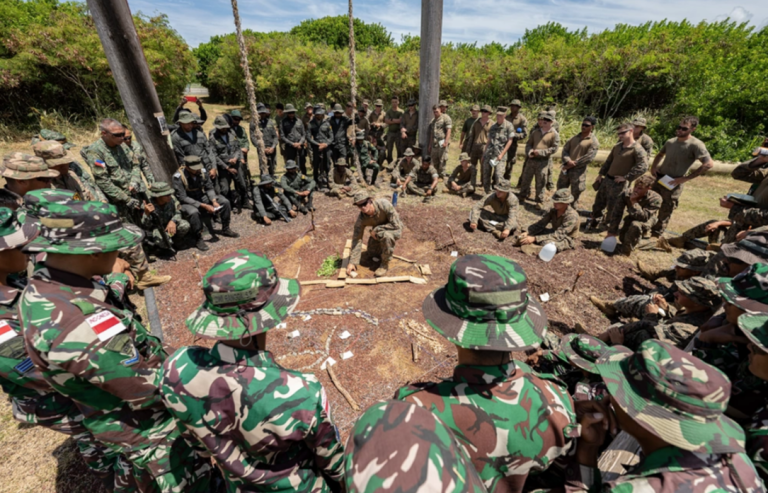
RIMPAC takes place on and below Hawaiian waters, on land, in the air, and in space and cyber domains with activities including anti-submarine warfare, mine clearance, explosive ordnance disposal, and amphibious raids. RIMPAC includes sinking exercises in which several countries coordinate to target, fire upon and sink decommissioned naval ships. RIMPAC also provides an opportunity to test new capabilities including unmanned systems and robotic surface vessel-fired missiles.
This comes as all major military spending metrics are on the rise: Global military spending is up. Nuclear weapons spending is up. U.S. military spending is up, and the Trump administration is calling for a record-smashing military budget increase to $1.5 trillion for fiscal year 2027. A recent report by the Project on Government Oversight argues that the true cost of military spending is vastly underestimated.
As a large-scale mobilization of military hardware crossed the Pacific Ocean to converge in Hawaii, Laurie Moore, executive director of the state’s Military and Community Relations Office (MACRO), told Truthout in an email, “RIMPAC isn’t just about ships and aircraft. It’s also about relationships.” She said Hawaii’s unique location and diverse population makes it a “natural place to bring partners together.”
RIMPAC does allow the militaries of different nations to cooperate in activities like urban combat and sniper training. During the 2018 RIMPAC, Japan’s Ground Self-Defense Force coordinated with the U.S. and Australia to fire HIMARS rockets in Japan’s first such launch from U.S. territory.
Moore said that “Hawaii’s land and ocean resources are among its greatest assets, and their protection must remain a priority,” adding, “MACRO supports continued efforts to incorporate lessons learned and ensure that training activities are carried out responsibly and with respect for Hawaii’s natural and cultural resources.” That message was delivered to RIMPAC participants in a MACRO-produced video presentation.
The U.S. military has faced increased scrutiny in Hawaii after a series of major fuel storage leaks contaminated residential drinking water in 2021. In May, the Institute for Policy Studies (IPS), the Cost of War Project, and others published a report entitled The True Cost of the Military in Hawaii which analyzes the economic, environmental, strategic, and social impacts of military activities in Hawaii. The report examines what it calls “the myth of military environmental stewardship.”
. . .
Economic Injection
Criticism of military activities in Hawaii can be a difficult position to take when so many residents and businesses depend on the military for their income, but the recent IPS report argues economic benefits are overstated and other costs are hidden. Organizations like MACRO and Hawaii’s Chamber of Commerce see RIMPAC as an important economic driver.
In an email to Truthout, Jason Chung, vice president of the Chamber of Commerce of Hawaii’s Military Affairs Council, praised RIMPAC’s contribution to Hawaii’s economy which he described as a “meaningful short-term economic injection for local businesses.”
The figure of $50 million injected into Hawaii’s economy is frequently cited as an economic impact of RIMPAC, although that number is over a decade old and its source is unclear. Hawaii’s Department of Business, Economic Development & Tourism did not respond to a query about RIMPAC’s economic benefit.
Chung also acknowledged the legitimacy of RIMPAC critics’ concerns about environmental stewardship and other community impacts and said there needs to be “transparency, accountability, mitigation, and sustained dialogue” between the military and local officials and affected communities.
“Any large event (military or non-military) creates impacts that should be communicated and managed. RIMPAC organizers should continue to engage early with the state and community, explain what is occurring and why, and demonstrate how concerns are addressed,” Chung said.
The U.S. Navy Third Fleet and RIMPAC organizers did not respond to multiple requests for comment.
Read the full story here.